

There was a time when work happened in one place and designers had studios, editors had edit suites, photographers had offices and production teams had headquarters.
Today, that's no longer the reality for many creators.
Your office might be an airport in the morning, a mountain in the afternoon, and a hotel room by evening.
For photographers, filmmakers, drone pilots, content creators, and production crews, work has become mobile.
And that changes everything.
The Modern Creator's Workspace
Look around on your next trip. You'll see creators editing videos from airport lounges. photographers delivering galleries from hotel rooms. filmmakers backing up footage from the back of a van and content creators managing campaigns from cafés halfway around the world.
The workspace is no longer fixed: It's wherever the work needs to happen.
The challenge is that most of us are still organizing our gear as if we worked from a permanent location.
We pack for transportation when what we really need is to organize for mobility.

Mobility Is More Than Carrying Gear
When people think about mobile workflows, they usually think about weight.
How much can I carry? How many bags do I need? Can I fit everything in my backpack?
Those questions matter, but they're not the most important ones.
The real question is:
Can I access what I need when I need it?
A perfectly packed bag can still be incredibly inefficient.
Because if every cable, battery, hard drive, and charger disappears into one giant compartment, you're carrying your office without being able to work from it.
Your Workflow Needs Layers
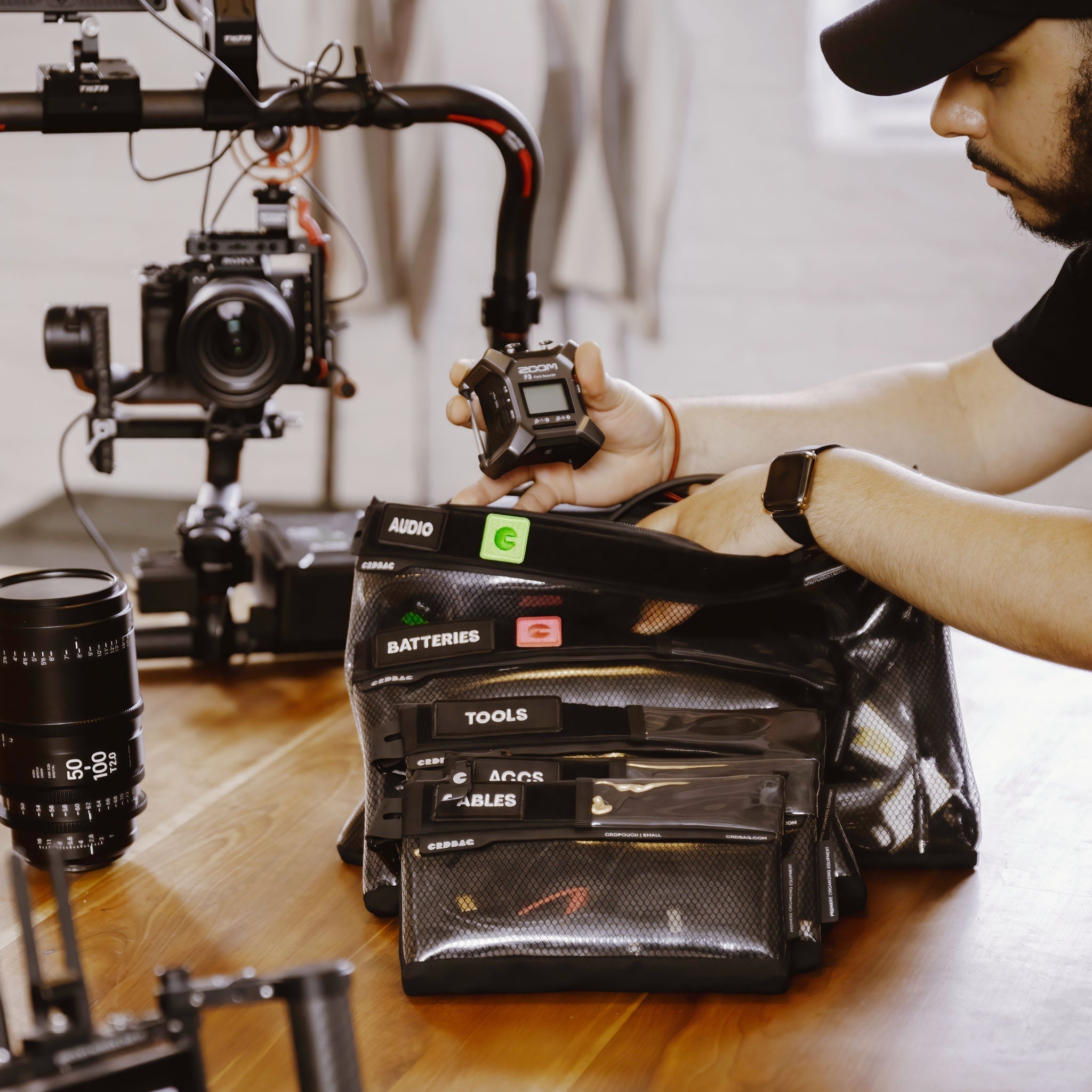
The best mobile setups aren't built around gear. They're built around categories.
Think about your day:
You don't need access to everything all the time, you need access to specific things at specific moments: Power, media, audio, travel essentials. tools, documents, charging equipment...
When these categories are separated into modules, your workflow becomes significantly easier to manage.
You stop searching through an entire backpack every time you need a battery and simply access the power module.
The same applies to every other category. The goal isn't to carry more, it's to access faster.

The Airport Test
One of the simplest ways to evaluate a mobile workflow is to imagine going through an airport.
You're standing at security. You need to remove your laptop, show a battery, access a charger or pull out a hard drive.
Maybe answer a quick email before boarding.
- How quickly can you find those items?
- How much unpacking is required?
- How much stress does the process create?
The airport is one of the best tests of organizational efficiency because it forces you to interact with your system under pressure.
Good systems feel calm. Bad systems feel chaotic.
Temporary Workspaces Need Permanent Systems
One of the biggest misconceptions about travel is that temporary environments require temporary organization.
The opposite is true.
The more your environment changes, the more important your system becomes.
A creator might work from:
-
a hotel room today
-
a production truck tomorrow
-
an airport lounge next week
The environment changes but the system shouldn't. Consistency creates familiarity and familiarity reduces friction.
No matter where you are in the world.
The Hidden Cost of Mobile Chaos
Most creators don't lose time because they're carrying too much gear, they lose time because they're carrying gear inefficiently.
Searching. Repacking. Untangling. Checking... Double-checking.
These small interruptions accumulate. Not only do they slow down the workflow, they consume mental energy, and creative work already demands enough mental energy on its own.
The less attention you spend managing your equipment, the more attention you can devote to creating.

The Goal Isn't Minimalism
Many people assume mobile workflows are about carrying less, and sometimes that's true, but mobility isn't really about minimalism. It's about intentionality.
You can carry a large setup and still be mobile or carry a small setup and still be inefficient.
The difference isn't quantity, it's organization.
Build a Workspace You Can Carry
The best mobile workflows share one characteristic:
They feel invisible.
You don't think about the system. You simply use it.
Everything has a place, is accessible and supports the work.
Because in today's world, your office isn't a room. it's whatever you're carrying on your back, and the better that mobile workspace functions, the more freedom you have to focus on what matters most:
Creating.

Hinterlassen Sie einen Kommentar
Alle Kommentare werden vor der Veröffentlichung moderiert.
Diese Website ist durch hCaptcha geschützt und es gelten die allgemeinen Geschäftsbedingungen und Datenschutzbestimmungen von hCaptcha.